
I am a huge fan of the YouTuber, FD Signifier. So, it's safe to say that I was really excited to see him discussing Aaron Pierre's Green Lantern and the bigger problem with British actors playing African American roles. There were some great things discussed in this, but I'd be lying if I didn't say I wasn't disappointed with some of the places that this discussion went. So I wanted to write down some of those thoughts somewhere that maybe someone might be able to find them one day.
Hopefully this is coherent and that it will be well-received – if anyone ever reads it.
The good stuff
First of all, I want to say that I'm happy with a lot of the things that were discussed and acknowledged by FD, in particular, in this discussion. I don't think many people know about the fact that Black British actors tend to be paid less than their American counterparts, which can have a huge impact on casting decisions. It was nice to have that brought up.
I also liked the fact that FD mentioned the fact that Americans can be quick to present their experiences of blackness as the definitive black experiences. It's easy to laugh at other parts of the diaspora and mock them for conflating their experiences with African American experiences, but it's often that way because many Americans (not just Black Americans) insist on making us believe that African Americans are the only authentic black people. It was nice for FD to acknowledge the hypocrisy there. It's often the same people being like 'this isn't your story' who simultaneously use those stories to claim blackness and gatekeep it from the rest of us.
I also think FD was right about the sanitisation and whitewashing of revolutionary figures. I agree that none of these films would count as good representations of black culture, since they strip the political views of these figures and make it seem like their grievances were interpersonal and have already been fixed, or that can be easily fixed by getting rid of a few bad eggs. They take revolutionary figures and make their history palatable, less uncomfortable. I'm glad FD raised that, to be honest.
Both FD and the host of this video (I don't know his name) spoke about why it would be nice for more African American characters should be played by African Americans, and I couldn't agree more. I dislike when people put on fake accents when there are definitely talented people from the place who could play the character well. It also does make me uncomfortable that these Black British actors could take these roles without feeding into the culture more and creating more space for more roles for black people. That's something that needs to be sorted out.
I also appreciated when the host said that he encourages African Americans to go out and see the world and experience what blackness is like throughout the rest of the world. It's such a powerful message that I think gets overlooked. We often experience American blackness and love it and embrace it. For us, someone like Kwame Ture helps us to understand our own experiences of the world around us better. So, it's nice to see Americans arguing that the same can be true, too.
But I wish he had done a little bit more of that listening and experiencing that he mentioned before he spoke, because there were a lot of issues with the presentation of this argument in the video.
The misunderstanding of the Windrush Generation
First of all, the host mentions that he went to see For Black Boys Who Have Considered Suicide When the Hue Gets Too Heavy by Ryan Calais Cameron when he was in London. I love that play, so I was really excited to find out his take on the situation - especially because he explicitly said that he was learning about the culture when he was there.
But then he mentioned that there was a whipping line that stood out to him and shocked him. He was confused as to why a Black British person would mention being whipped in their history and argued that we British people should focus on our own struggles with racism rather than co-opting the struggles of the Americans.
He mentioned that we should focus on the Windrush Generation and other uniquely British experiences and suggested that the person who wrote For Black Boys was descended from Nigerian immigrants who didn't experience slavery.
There's one big problem with this: the writer of For Black Boys, Ryan Calais Cameron, is of Guyanese descent.
Guyanese black people also descend from slaves.
I don't know why, but the video host seems to think that the Windrush Generation came from Nigeria and settled in the UK. He seems to think that this means they have no understanding of slavery, and so mentioning it would be out of place for them. But that's wrong for multiple reasons.
For one, the Windrush Generation comes from the Caribbean. The black people in the Caribbean are there for the same reasons as African Americans. That's the reason why we share so much, like the West African stories and traditions, as well as the generational trauma that came with being slaves.
But there's also the problem that while Nigeria wasn't the end destination for chattel slavery, it was the start – along with many other places across the West Coast of Africa. In many of these places, including Ghana and Sierra Leone, the European slave traders set up slave factories where they could keep the African people before they sent them abroad to the Americas. And you can guarantee that whipping was a part of that experience.
It's just quite disappointing to me that a person's reaction to being presented with new information about the experiences of Non-American black people would be 'they're copying from us' instead of, 'Huh? Why would they have knowledge of being whipped? Maybe I need to look that up more.'
The American claim on slavery
Then there's the fact that they seemed to keep acting like slavery was unique to the USA. The host called slavery 'American slavery', like it wasn't something that happened all across the so-called 'New World'.
In reality, there's a reason Haiti revolted. There's a reason black people exist in the Caribbean. There's a reason they exist in Brazil and Colombia and other places in South America, too. And actually, there were more slaves sent to Brazil during the Transatlantic Slave Trade and it lasted longer than it did in North America.
Slavery isn't the thing that is unique to the African American experience. If you mentioned segregation and the Jim Crow Laws, that would be different. Those things are definitely inventions of the USA (although we did have our own equivalents, and there was Apartheid in South Africa). But chattel slavery is the thing that unites a huge chunk of the diaspora; it's not unique to Americans only.
It feels ironic to me that they can spend multiple minutes of the video agreeing that there is a certain level of ignorance about black people from the USA when they are actively contributing to it themselves by misunderstanding why someone descended from the Windrush Generation would have the same kind of generational trauma when it comes to slavery.
It's a shame that they made it seem this way. It's just such terrible misinformation that serves to fuel the diaspora wars, when I know that's not what the creators of this video would have wanted.
I think one of the worst things for me was posting a comment on the video and having an American try to argue against me with the fake information. They thought chattel slavery was unique to the USA. It really makes me worry about the exceptionalist way that the history of slavery is taught in the USA.
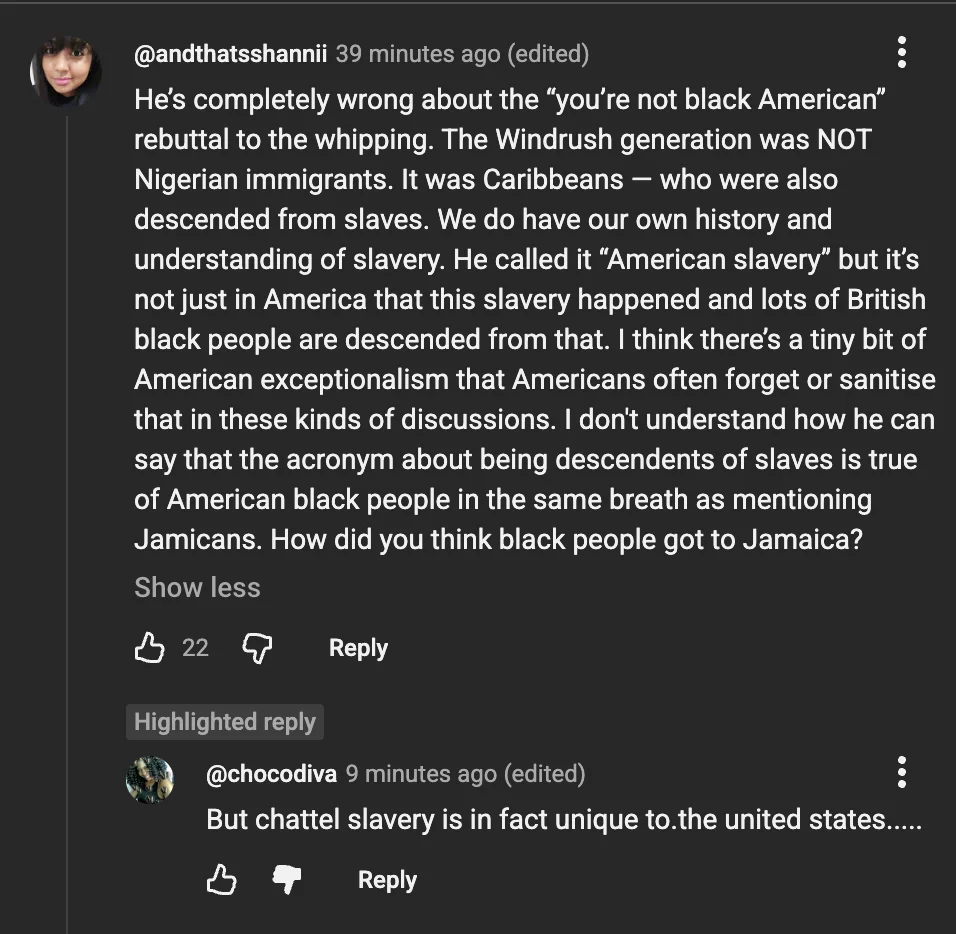
Did no one teach these kids about Nanny of the Maroons, for example? Or the Haitian Revolution? Did no one really sit down and listen to the revolutionary Caribbean musicians? Like Bob Marley's Slave Driver? It's shocking how much we learn about the USA and how little they learn about countries literally right next door to them. The system has completely failed them. It's left them with huge gaps in their understanding that make it difficult for them to fully analyse the world as it is – even thoughtful people like the host in this Waving the Red Flag video.
And it makes me question, too, why they didn't just look it up before they said anything at all. Is it a mistrust of books, or a lack of books? Is it that they've never been taught what the term 'chattel slavery' means? Did they come up with that lie about history themselves? Or is it something that someone taught them?
What do they think the difference is between American slavery and the slavery of, say, Haiti, Brazil, Cuba and Jamaica? Do they think chattel slavery means when you do slavery but American-ly? What else would the difference be? Or do they think that the black people in the Caribbean and South America are actually indigenous people? Why would slavery stop in the USA when the border between the USA and Canada didn't even exist when slavery started?
I'm so concerned and alarmed by this.
The scarcity of Black British roles
I also want to note that because African Americans have controlled the narrative of what it means to be black, it's relatively hard for black actors to break out and make big money unless they are playing African American roles.
Hollywood is still hugely popular and still dominates Western cinema. Arguably, it still dominates global cinema. So pursuing roles in Hollywood is where you're going to get most of your money from as an actor.
And since that's the case, a lot of the roles these actors play will be American, since Hollywood mostly tells stories about America.
Actors do often come back to the UK and try to make their name in the UK scene, but there's not a lot of work out here for them. And the work in Hollywood is often to play African American characters. It would be nice if we could find ways to give non-American cinema its chance. It really deserves it, to be honest! There are so many hidden gems that Americans are definitely not seeing, for example. It didn't seem like FD had seen Small Axe, for example. And I think that everyone should see Mangrove from that anthology.
We're all part of the problem.
With the summer holidays nearly over, I think it's time for me to make an academic New Year's Resolution.
This year's resolution is a simple one: I'm gong to make the active choice to avoid letting technology tell me what to think and what to be entertained by.
I can't tell you how many hours I've wasted on TikTok or YouTube Shorts mindlessly scrolling through pointless content. Every single one of those hours is an hour I can't get back to do useful things, like working on my degree, watching a film or TV show I might fall in love with, or challenging myself to think differently.
In fact, I spend so much out-of-work time scrolling mindlessly through content that I know doesn't have much value to me that I haven't even finished Clair Obscur: Expedition 33 yet! I originally put it on time out because it made me cry too early on in the game (no spoilers), but at this point, it's just because I'm wasting so much time that I think I have none.
And then we get to AI.
I've said so many times that I'm actually quite AI-ambivalent. But there's one thing for sure: like I said in my rant about the state of the term 'polymath', knowing facts is not the same as building knowledge. And I want to spend this academic year building knowledge. I'm done with filling my head with useless facts that leak out again in two minutes.
I also want to support people more. I don't want things to actually become like the Dead Internet Theory. I love the fact that the internet is made up of human content that other people spent hours of their time making. And as annoying as ads are, I would happily scroll through twenty of them to read the perspectives of a real human being.
So, I'm going to make a conscious effort to ensure that the content I consume is more human. Instead of reading the AI summary for something, I'll go on to Wikipedia, which has said that it will not allow AI generated content to be used for its pages. I remember a time when teachers used to tell students not to use Wikipedia. In fact, I wrote a blog post about not using it wholesale years ago. Now, it's the better alternative.
I'm not going to completely give up on short-form content, but the idea of mindlessly swiping on my For You Page is out. I'm going to try to figure out a way to stop my YouTube app from going straight to Shorts when I open it. When I do watch short-form content, I'll be more intentional about what I watch. I'll watch the stuff that my husband pebbles me with throughout the day as part of his love language, and I'll turn on all notifications for a select few creators whose content I'd like to see when it comes out.
Also, I've ordered a set of newspapers and magazines that I'll be reading each month. Really, if I want to be part of the change, I should be promoting an art form that's in a little bit of trouble (but not yet near dead) at the moment – especially since I recently did complain about the loss of the Hodder Education magazines. I want to support the industry, and I find that I read better physically anyway.
I'm also aware that magazines are to books what TikTok videos are to long-form YouTube videos – except that magazines don't have the same damaging effects on attention span as short-form content that you can easily scroll through. Magazine articles are short and made to entertain just like shorts are, but they take longer to consume.
Plus, I love the fact that I can keep hold of it and find it again. I can mark them with little index sticky note thingies and annotate the hell out of them. One of my biggest problems online at the moment is that I can never find the interesting content I watched ages ago, which makes it hard to reference or credit the people who deserve it. And I can't refer back to things to check what I know, remember what I thought about the content in the past.
It's a bit like what Charlie Brooker said in The Guardian back on 2013: sometimes, all of this content feels a little bit like 'factor[ies] mindlessly pumping carbon dioxide into a toxic sky'. He felt like that well before the invention of AI when people had to actually sit down and type out their content one word at a time. Now, people don't even need to do that. They write a 100-word prompt and then AI generates them a 2000 word article or script in less than five minutes.
It's no wonder I can't keep up or remember any of the stuff I've consumed! I'm not savouring it or even stopping to mull over what I've just been baraged with.
To borrow a term from Viktor Šhklovsky, I've experienced the automatisation towards information, and I don't want to be like that anymore. I want to be wowed by information again.
So I, Shani Cipro, am going to make an effort this academic year to change my consumption habits. I'm going to do my best to be more conscious about what I read, watch and listen to. I'll support real humans writing real things as much as possible. I might slip up, but by darn I've got to try.
P.s. Here are some of my recommendations for magazines and other content I'm going to be using:
- Philosophy Now
- The Hipcrime Vocab
- Babel
- London Review of Books
- EMC Emag
- History Today
- The Philosophers' Magazine
- I would use the Hodder magazines if they let me!!!
They aren't going to make me experts on anything, but they'll make me think. And that's the most important thing.
I am quite an AI ambivalent person. I think if we could find ways to not destroy the planet and water systems and avoid kicking people out of their homes, there are probably some really good uses of AI. But I'm not excited by it.
The thing is, AI could be really useful and help us create a utopian society. Or, it could herald in an absolute dysopia. The line between whether it does one or the other is quite thin. But right now? It seems like we're going down the worst possible path.
I could say plenty about all the terrible ways that AI is screwing us up. Here are a list of some of the things that should give us all pause:
- Palantir, a surveillance company linked to the mass deportations in the USA, is connected to our NHS and has way too much information about us and our data.
- I'm genuinely worried about AI Psychosis. I mean, we're already dealing with a rise in loneliness, and being able to retreat further into yourself and talk to a bot like it's human isn't going to help.
- People are offloading some key thought processes and creative processes to AI, and it's robbing them of opportunities to learn and improve.
- AI is slowly moving towards a process of self-cannibalisation. As Google and other search engines use more AI, people are clicking on genuine, human-made content less and less. That gives people less of an incentive to write new things online, which means the amount of new, human-made data is slowly being reduced. Eventually, we could get into a situation where AI is training on its own data! We're rapidly moving towards the Dead Internet Theory being a real thing.
- I've noticed that as my students are consuming more AI content, their own writing sounds more and more like AI. I'm worried about them losing their own creative voices and also being accused of AI plagiarism in the future.
- The more AI we see, the less we recognise it. And so many of us think that we're excellent at rooting out AI when we're not as good as we think we are. And thinking you're an AI sniffer dog makes you more likely to be duped because of course you couldn't have missed an AI image or video use!
- Ai is quite easy to trick. I mean, most models have moderation standards to stop users from getting illegal information or methods of hurting themselves from AI, but they're very easy to bypass!
- It seems like people are losing control of their AIs. The AI models are breaking out of containment and deciding to hack other software and companies to get key information! If that isn't the most Terminator-eque thing you've heard of...
At the same time, there are some genuinely useful ways that we could use AI.
How we could use AI positively
In my ideal, utopian world, AI would be used to do all the menial tasks that people don't want to do. That means we humans could spend more of our times creating new art, innovating, having new ideas, connecting with each other, learning new things and improving ourselves.
I think there are also some important real-world uses of AI. For example:
- It can be a really interesting way to make starting a business more accessible at a cheaper budget. Right now, making sure you're compliant with all the global rules about privacy, data protection, transparency etc can be really difficult and it's expensive to hire a professional to draft these policies for you. I'd be lying if I didn't get help from AI to make some of my business policies because it's cheaper and means I can focus on making Shani's Tutoring run smoother.
- It can be really useful for people with disabilities. For example, text-to-speech and speech-to-text softwares are examples of AI (but not generative AI). That can be useful for people with mobility or sight issues.
- AI can help us to translate important things (which is useful for helping the world be more interconnected.
- Language teachers are often expensive. So talking to an AI in something like Duolingo early in your language learning journey might not be as good as talking to a real human, but it's better than not speaking to anyone at all!
- I read somewhere that once perfected, AI and supercomputers can be useful for helping us to test different medical treatments quickly in controlled environments.
To be honest, I do think AI is going to be used in some capacity for the foreseeable future. I don't think it's going to be as ubiquitous as it is at the moment, but it will be used. And so it's important that we understand it and know how to harness it for our own good.
A personal AI gripe as a teacher and course creator
But while there are some great, useful uses of AI and we need to make sure we understand it, there is one that's annoyed me: how much people are using AI in course creation.
I see it everywhere. Every single Wordpress LMS system boasts that you can use AI to create courses from scratch. Software like Wayground and Kahoot is doing something similar, too: giving you the ability to make quizzes, courses, curricula with just a few mouse clicks.
But I wonder: what's the point?
Why should a student buy my course if I've not even used my expertise to create it?
I mean, after all, they'd just need to come up with the same prompts I did and they could have the course I put online at a fraction of the price.
So the people who create these LMSs don't understand good learning design (I'm not surprised, since so few let you break lessons into smaller units, which is a basic way to improve learning design). They just don't get it. It feels like they're just jumping on the AI bandwagon and finding as many ways as possible to implement it without actually thinking about the consequences.
If course creators advertise AI-made courses, aren't they basically saying, 'I'm obsolete'? Isn't it the same as saying you're not important in the course creation process?
I mean, when I sell courses, I want to sell MY expertise. And if I'm not doing that, if I'm just spitting out something that another person or machine made, why should I be charging money for it?
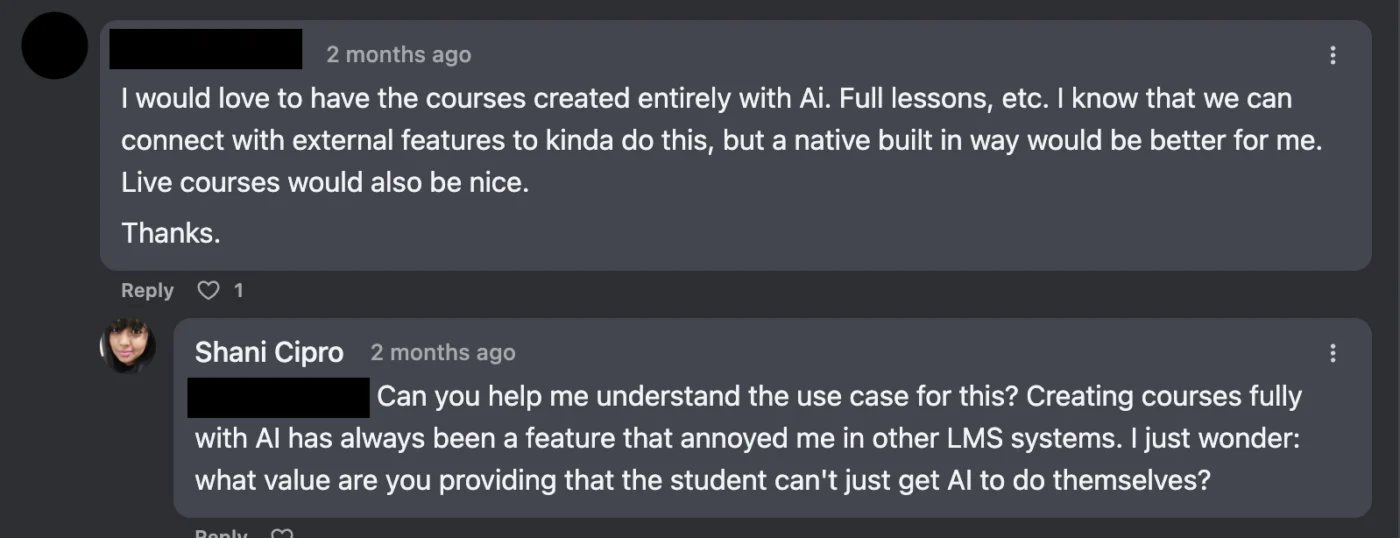
I actually asked this question to someone on a community I'm part of not long ago. They didn't have an answer for me, but I am really worried about where the world is going.
I was never a fan of dropshipping, but this seems worse. It's a form of knowledge dropshipping that doesn't even pay the people who provided the knowledge in the first place.
I stumbled across a discussion on r/polymath the other day that really disturbed me.
Someone asked for recommendations of newspapers, magazines, journals etc that people on the subreddit follow as part of their journey to becoming a polymath, and multiple people said that they don't add any of those things to their knowledge diets!
Some said that they just go on other subreddits where they can read the answers of experts in the field. This wasn't the most egregious answer, because there are definitely experts hanging out on Reddit who come in and add their contributions regularly. I literally go to r/A-levelEnglishLit to do that! But there is one huge problem with thinking you can just pop on a subreddit and find everything out that you need to know:
How do you know that you're actually reading the work of experts, and not just some very confident, very wrong people?
I'm not saying that newspapers and magazines are infallible. I'm just saying that it's wild to me that people on a subreddit dedicated to becoming knowledgable in multiple areas could think it's enough to go on a social media platform where anyone can post anything they want and expect to learn more than published content that holds itself to standards of accuracy.
But the real thing that alarmed me is how many people were claiming that AI is the way to becoming a polymath. They said some horribly incorrect things: if you combine AI with YouTube and Reddit, you can learn the important things you need to know.
I hope I can explain to you in a few bullet points why that isn't true:
- AI isn't necessarily trained on accurate or up-to-date information. It's just trained on text. After all, especially early on, the concern was to get AI to respond as if it understands you, not to be accurate or truthful.
- YouTube and Reddit doesn't have high (if any) standards of accuracy. Reddit moderators on some subreddits try their best, but it's a thankless task and it's not like it's their full-time jobs to fact-check everything that comes through their doors.
- When you don't know anything about a subject or know very little, using AI and Reddit and other tools that are giving you information confidently will make you believe things even if they aren't true. To use AI well, you have to already know enough about the topic to call out when it's wrong. Otherwise, it just makes you let your guard down and believe nonsense.
- The point of learning stuff isn't just to cram useless facts in your head. Knowledge isn't the same as fact gathering. Knowledge is about how you process the information, how you connect it to existing information, and what you do with it afterwards. Facts are meaningless if they don't come with a good deal of thorough thought. Slowing down and reading books is a great way to encourage you to think, not just to absorb (see my short comments on The Literacy Crisis by Michael Burns for more on that)
But I don't know why I'm surprised. The term 'polymath' is fraught with people who treat knowledge like it's money and our brains like a bank account. Or like they're trying to 100% facts like trophies in a video game.
In reality, that's not how things work. There is a great deal of benefit to engaging with posts on Reddit and watching YouTube videos. In fact, I'm AI ambivalent! I genuinely think there are good uses of AI, too! But not if you're just trying to cram as many useless facts in your brain as possible.
And the whole subreddit is cringe, to be honest.
I woke up pretty early this morning, so I thought I would watch a video by Michael Burns. He has recently worked on a lot of stuff that I think is useful to think about.
One of the really interesting things this video talks about is the importance of slowing down. He quotes multiple other people who talk about the importance of spending some time thinking about the implications of a text before reacting to it, including The Hipcrime Vocab and Immediacy by Anna Kornbluh.
For me as a literary linguist in training, I think the most interesting part was how this links to the theory of defamiliarisation that came to us from Russian Formalism (particularly from Viktor Šhklovsky's 'Art as Technique') into stylistics.
The idea is that we tend to experience 'habitualisation' or 'automatisation' when we experience the same thing over and over again. The point of literature is to see that thing with fresh eyes. He says something really interesting that I think links to what Burns says in this video and should definitely be added to the discussion:
In studying poetic speech in its phonetic and lexical structure as well as in its characteristic distribution of words and in the characteristic thought structures compounded from the words, we find everywhere the artistic trademark – that is, we find material obviously created to remove the automatism of perception; the author's purpose is to create the vision which results from that deautomatized perception. A work is created "artistically" so that its perception is impeded and the greatest possible effect is produced through the slowness of the perception. As a result of this lingering, the object is perceived not in its extension in space, but, so to speak, in its continuity.
For me, this is really important. Burns touched on how algorithms, AI and other mechanisms are actively changing the way we think; that we're absorbing information rather than mulling it over in our heads. It's made us more malleable and easier to manipulate. I think the more we can break out of that, the better.
This year, I am making a concerted effort to try to think more and blindly consume less. I've not stopped watching video essays or listening to podcasts. In fact, I haven't even stopped watching short-form content completely! But I am being more intentional about what I read and how. I'm bringing more magazines and journals back into my reading, picking up newspapers when I go to the shop and reading that (or The Week, the summary magazine) and just generally trying my best to slow down and think about what I'm doing. Burns's video came out at the perfect time for me to articulate my plans for the next 12 months.
Michael Burns's reading list is excellent! I think there's so much that we can learn from him. I recommend checking it out. It's a bit of a shame that bookshop.org doesn't automatically transfer affiliate links from the American site to the British one if the person who clicked the link because I don't think me buying the book from bookshop.org UK will help him in any way.
I get notifications on LinkedIn for jobs in the Curriculum Design and Learning Design spheres because I have a great deal of experience with that. I've been creating my own courses using Moodle and other LMS solutions since 2020!
But why is it that every single job out there right now is either for an AI-based platform or expects you to use AI to make the curriculum to some extent? I get that AI makes people faster at creating content, but it raises so many questions for me:
- Doesn't it make it harder for people to catch AI hallucination if they're just plugging stuff into AI?
- Why would you pay me to prompt AI when you could do it yourself?
- What value are students getting when we use AI? I mean, they could just do the same, right? That's the whole point I was making in my other, recent post about AI!
- Why would we want to make ourselves obsolete by helping AI to replace us?
In my ideal world, AI would never be used in the creation of the original course. Rather, it would be used later to help sort and present course data, questions and feedback so that I can answer these things better.
I mean, we should be getting AI to do what it's good at, right? And generally, computers are good at pattern recognition and helping to notice correlations that we can then consider the meaning of.
I've messed around with AI in the course creation process. It creates really superficial lessons that don't really teach anything. They just present information that can easily be found online for free by humans and put it in a bullet point format.
I'd much rather reward humans with my views – especially because their content is being used by AI in the first place without their credit. I want to go to the source and get people's perspectives and ways of explaining things.
It's really worrying.
This website is a bit of a personal blog for me. I'm going to be writing personal-professional blog posts to build my own digital footprint in a way that I feel is positive and reflects what I actually think and feel.
I'm doing this for a few different reasons. The main one is because I'm a business owner, teacher and academic in training. People Google me all the time – whether they're students or possible future customers. I want to make sure that the image of me online is one that I can truly stand behind.
Also, the surname I took on marriage, Cipro, is lovely. But it's also the name of a type of medication! I want to make sure that when people search 'Shani Cipro', they see the neurodivergent educator, the English Literary Linguistics enthusiast who's doing an MA, teaching, and acting as a business owner all the time. Maybe they'll see that I love reading and gaming and anime and all sorts of geeky stuff, rather than a random medicine not related to me at all.
My maiden name, Shani Thanki-Franklin, doesn't have the associations with medication, but it's long and a mouthful to say. I used to hate the fact that my surname meant that I was one of the last people to be called out on the register in school. I mean, I have ADHD and it's hard to focus for long periods of time. So, having to wait for 20 other students to say 'here' before I could meant I was more likely to miss my name being called out and get in trouble. Cipro is the start of the register. So if I have kids and they end up with ADHD like me, I know that they're more likely to catch their names before they zone out. I also like the fact that my name is unusual enough that people aren't making assumptions about me or who I am before they meet me. So it's important for me to build up my name as Shani Cipro.
Plus, I have a disgruntled member of an old forum I used to manage (no longer managed by me) who regularly posts outrageous claims about me with my real name. They've threatened to leak my address and email addresses, and are making very defamatory claims about me. I am seeking legal advice on the matter, but this has been going on since January 2020, so I also want to just control the narrative about who I am a little. Even if the things she's saying are very difficult to believe (and some would require me to be able to do magic), it's still not nice to have these claims about you online.
Then there's the fact that I feel like I just haven't written enough lately. I used to love writing online. But then I brought money into it and SEO and it felt like every time I sat down to write, I'd come up with 6 other things I should post before the blog post I was working.
Why? Well, if I wanted to post about how to find a good text for your English Literature A-level NEA, for example, wouldn't it make sense for me to actually provide a post where I create a list of my own recommendations to link to first? That will increase internal interlinking, which is good for SEO. But then I start making the recommendations and realise I have too many of them. So it's better to create a new custom post type for NEA recommendations. I start doing that, then I have to find a way to make the template look good. It ends up creating so much work for me! And it paralyses me. Makes me feel like I can't write at all.
You can probably see the ADHD thought process right there, right? Five or six interconnected thoughts spilling out of me so fast that it's hard to catch them. That makes writing for a business overwhelming at the moment, and it's given me a kind of writer's paralysis. No writer's block, exactly. I've got plenty of ideas. I just can't initiate the task because it feels like a huge mountain to climb. So I figured that starting to write more regularly for my own personal space might be a good way to break out of that bubble.
And that brings me to why I started the Cafe in the first place. I mean, I started a whole FluentCommunity instance just to talk to myself here? Well, kinda! I mean, I'd welcome other people if they were interested in joining, but it's not like I expect a dedicated fanbase of people who want to join a community dedicated to my image. So why make a forum just for myself?
Well, just like I said, the ADHD thoguht process can make me feel like I can't even begin writing. I'm good at writing blogs and they do well when I finally get them out. But structuring them well, making sure I've got enough headings, that all the thoughts go to the right places... it feels like a form of digital masking. It's tiring. Lots of spoons being used.
So I figured: why not create a diary space for myself? I made the Cafe to be able to post more rambling or (more charitably) less structured, more spontaneous updates about my life, my thoughts and general ideas. Plus, it's a great record of what I was up to at the moment for when my ADHD poor memory takes over.
So, please don't feel obligated to join this community or even read these. If you have thoughts, I'm happy to answer! I definitely would welcome the support. And I can promise I'll never use AI to make these – especially given my thoughts on AI. But I don't expect anyone to come here. I'm just writing into the void and hoping it means anyone who wants to Google me knows just who Shani Cipro is.
This video gave me chills. And I want to start using this space to share the things I'm thinking about in the moment.