
The Misunderstanding of Black British Culture
I am a huge fan of the YouTuber, FD Signifier. So, it's safe to say that I was really excited to see him discussing Aaron Pierre's Green Lantern and the bigger problem with British actors playing African American roles. There were some great things discussed in this, but I'd be lying if I didn't say I wasn't disappointed with some of the places that this discussion went. So I wanted to write down some of those thoughts somewhere that maybe someone might be able to find them one day.
Hopefully this is coherent and that it will be well-received – if anyone ever reads it.
The good stuff
First of all, I want to say that I'm happy with a lot of the things that were discussed and acknowledged by FD, in particular, in this discussion. I don't think many people know about the fact that Black British actors tend to be paid less than their American counterparts, which can have a huge impact on casting decisions. It was nice to have that brought up.
I also liked the fact that FD mentioned the fact that Americans can be quick to present their experiences of blackness as the definitive black experiences. It's easy to laugh at other parts of the diaspora and mock them for conflating their experiences with African American experiences, but it's often that way because many Americans (not just Black Americans) insist on making us believe that African Americans are the only authentic black people. It was nice for FD to acknowledge the hypocrisy there. It's often the same people being like 'this isn't your story' who simultaneously use those stories to claim blackness and gatekeep it from the rest of us.
I also think FD was right about the sanitisation and whitewashing of revolutionary figures. I agree that none of these films would count as good representations of black culture, since they strip the political views of these figures and make it seem like their grievances were interpersonal and have already been fixed, or that can be easily fixed by getting rid of a few bad eggs. They take revolutionary figures and make their history palatable, less uncomfortable. I'm glad FD raised that, to be honest.
Both FD and the host of this video (I don't know his name) spoke about why it would be nice for more African American characters should be played by African Americans, and I couldn't agree more. I dislike when people put on fake accents when there are definitely talented people from the place who could play the character well. It also does make me uncomfortable that these Black British actors could take these roles without feeding into the culture more and creating more space for more roles for black people. That's something that needs to be sorted out.
I also appreciated when the host said that he encourages African Americans to go out and see the world and experience what blackness is like throughout the rest of the world. It's such a powerful message that I think gets overlooked. We often experience American blackness and love it and embrace it. For us, someone like Kwame Ture helps us to understand our own experiences of the world around us better. So, it's nice to see Americans arguing that the same can be true, too.
But I wish he had done a little bit more of that listening and experiencing that he mentioned before he spoke, because there were a lot of issues with the presentation of this argument in the video.
The misunderstanding of the Windrush Generation
First of all, the host mentions that he went to see For Black Boys Who Have Considered Suicide When the Hue Gets Too Heavy by Ryan Calais Cameron when he was in London. I love that play, so I was really excited to find out his take on the situation - especially because he explicitly said that he was learning about the culture when he was there.
But then he mentioned that there was a whipping line that stood out to him and shocked him. He was confused as to why a Black British person would mention being whipped in their history and argued that we British people should focus on our own struggles with racism rather than co-opting the struggles of the Americans.
He mentioned that we should focus on the Windrush Generation and other uniquely British experiences and suggested that the person who wrote For Black Boys was descended from Nigerian immigrants who didn't experience slavery.
There's one big problem with this: the writer of For Black Boys, Ryan Calais Cameron, is of Guyanese descent.
Guyanese black people also descend from slaves.
I don't know why, but the video host seems to think that the Windrush Generation came from Nigeria and settled in the UK. He seems to think that this means they have no understanding of slavery, and so mentioning it would be out of place for them. But that's wrong for multiple reasons.
For one, the Windrush Generation comes from the Caribbean. The black people in the Caribbean are there for the same reasons as African Americans. That's the reason why we share so much, like the West African stories and traditions, as well as the generational trauma that came with being slaves.
But there's also the problem that while Nigeria wasn't the end destination for chattel slavery, it was the start – along with many other places across the West Coast of Africa. In many of these places, including Ghana and Sierra Leone, the European slave traders set up slave factories where they could keep the African people before they sent them abroad to the Americas. And you can guarantee that whipping was a part of that experience.
It's just quite disappointing to me that a person's reaction to being presented with new information about the experiences of Non-American black people would be 'they're copying from us' instead of, 'Huh? Why would they have knowledge of being whipped? Maybe I need to look that up more.'
The American claim on slavery
Then there's the fact that they seemed to keep acting like slavery was unique to the USA. The host called slavery 'American slavery', like it wasn't something that happened all across the so-called 'New World'.
In reality, there's a reason Haiti revolted. There's a reason black people exist in the Caribbean. There's a reason they exist in Brazil and Colombia and other places in South America, too. And actually, there were more slaves sent to Brazil during the Transatlantic Slave Trade and it lasted longer than it did in North America.
Slavery isn't the thing that is unique to the African American experience. If you mentioned segregation and the Jim Crow Laws, that would be different. Those things are definitely inventions of the USA (although we did have our own equivalents, and there was Apartheid in South Africa). But chattel slavery is the thing that unites a huge chunk of the diaspora; it's not unique to Americans only.
It feels ironic to me that they can spend multiple minutes of the video agreeing that there is a certain level of ignorance about black people from the USA when they are actively contributing to it themselves by misunderstanding why someone descended from the Windrush Generation would have the same kind of generational trauma when it comes to slavery.
It's a shame that they made it seem this way. It's just such terrible misinformation that serves to fuel the diaspora wars, when I know that's not what the creators of this video would have wanted.
I think one of the worst things for me was posting a comment on the video and having an American try to argue against me with the fake information. They thought chattel slavery was unique to the USA. It really makes me worry about the exceptionalist way that the history of slavery is taught in the USA.
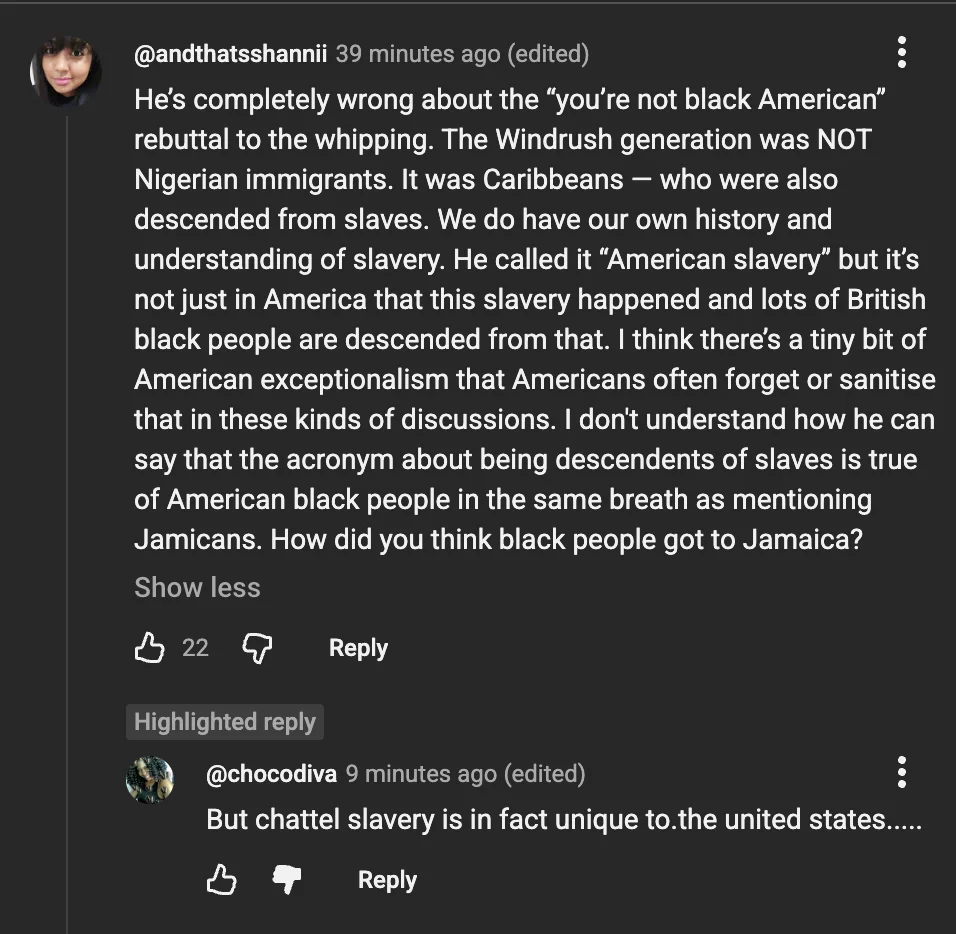
Did no one teach these kids about Nanny of the Maroons, for example? Or the Haitian Revolution? Did no one really sit down and listen to the revolutionary Caribbean musicians? Like Bob Marley's Slave Driver? It's shocking how much we learn about the USA and how little they learn about countries literally right next door to them. The system has completely failed them. It's left them with huge gaps in their understanding that make it difficult for them to fully analyse the world as it is – even thoughtful people like the host in this Waving the Red Flag video.
And it makes me question, too, why they didn't just look it up before they said anything at all. Is it a mistrust of books, or a lack of books? Is it that they've never been taught what the term 'chattel slavery' means? Did they come up with that lie about history themselves? Or is it something that someone taught them?
What do they think the difference is between American slavery and the slavery of, say, Haiti, Brazil, Cuba and Jamaica? Do they think chattel slavery means when you do slavery but American-ly? What else would the difference be? Or do they think that the black people in the Caribbean and South America are actually indigenous people? Why would slavery stop in the USA when the border between the USA and Canada didn't even exist when slavery started?
I'm so concerned and alarmed by this.
The scarcity of Black British roles
I also want to note that because African Americans have controlled the narrative of what it means to be black, it's relatively hard for black actors to break out and make big money unless they are playing African American roles.
Hollywood is still hugely popular and still dominates Western cinema. Arguably, it still dominates global cinema. So pursuing roles in Hollywood is where you're going to get most of your money from as an actor.
And since that's the case, a lot of the roles these actors play will be American, since Hollywood mostly tells stories about America.
Actors do often come back to the UK and try to make their name in the UK scene, but there's not a lot of work out here for them. And the work in Hollywood is often to play African American characters. It would be nice if we could find ways to give non-American cinema its chance. It really deserves it, to be honest! There are so many hidden gems that Americans are definitely not seeing, for example. It didn't seem like FD had seen Small Axe, for example. And I think that everyone should see Mangrove from that anthology.
We're all part of the problem.