Thoughts on AI
I am quite an AI ambivalent person. I think if we could find ways to not destroy the planet and water systems and avoid kicking people out of their homes, there are probably some really good uses of AI. But I'm not excited by it.
The thing is, AI could be really useful and help us create a utopian society. Or, it could herald in an absolute dysopia. The line between whether it does one or the other is quite thin. But right now? It seems like we're going down the worst possible path.
I could say plenty about all the terrible ways that AI is screwing us up. Here are a list of some of the things that should give us all pause:
- Palantir, a surveillance company linked to the mass deportations in the USA, is connected to our NHS and has way too much information about us and our data.
- I'm genuinely worried about AI Psychosis. I mean, we're already dealing with a rise in loneliness, and being able to retreat further into yourself and talk to a bot like it's human isn't going to help.
- People are offloading some key thought processes and creative processes to AI, and it's robbing them of opportunities to learn and improve.
- AI is slowly moving towards a process of self-cannibalisation. As Google and other search engines use more AI, people are clicking on genuine, human-made content less and less. That gives people less of an incentive to write new things online, which means the amount of new, human-made data is slowly being reduced. Eventually, we could get into a situation where AI is training on its own data! We're rapidly moving towards the Dead Internet Theory being a real thing.
- I've noticed that as my students are consuming more AI content, their own writing sounds more and more like AI. I'm worried about them losing their own creative voices and also being accused of AI plagiarism in the future.
- The more AI we see, the less we recognise it. And so many of us think that we're excellent at rooting out AI when we're not as good as we think we are. And thinking you're an AI sniffer dog makes you more likely to be duped because of course you couldn't have missed an AI image or video use!
- Ai is quite easy to trick. I mean, most models have moderation standards to stop users from getting illegal information or methods of hurting themselves from AI, but they're very easy to bypass!
- It seems like people are losing control of their AIs. The AI models are breaking out of containment and deciding to hack other software and companies to get key information! If that isn't the most Terminator-eque thing you've heard of...
At the same time, there are some genuinely useful ways that we could use AI.
How we could use AI positively
In my ideal, utopian world, AI would be used to do all the menial tasks that people don't want to do. That means we humans could spend more of our times creating new art, innovating, having new ideas, connecting with each other, learning new things and improving ourselves.
I think there are also some important real-world uses of AI. For example:
- It can be a really interesting way to make starting a business more accessible at a cheaper budget. Right now, making sure you're compliant with all the global rules about privacy, data protection, transparency etc can be really difficult and it's expensive to hire a professional to draft these policies for you. I'd be lying if I didn't get help from AI to make some of my business policies because it's cheaper and means I can focus on making Shani's Tutoring run smoother.
- It can be really useful for people with disabilities. For example, text-to-speech and speech-to-text softwares are examples of AI (but not generative AI). That can be useful for people with mobility or sight issues.
- AI can help us to translate important things (which is useful for helping the world be more interconnected.
- Language teachers are often expensive. So talking to an AI in something like Duolingo early in your language learning journey might not be as good as talking to a real human, but it's better than not speaking to anyone at all!
- I read somewhere that once perfected, AI and supercomputers can be useful for helping us to test different medical treatments quickly in controlled environments.
To be honest, I do think AI is going to be used in some capacity for the foreseeable future. I don't think it's going to be as ubiquitous as it is at the moment, but it will be used. And so it's important that we understand it and know how to harness it for our own good.
A personal AI gripe as a teacher and course creator
But while there are some great, useful uses of AI and we need to make sure we understand it, there is one that's annoyed me: how much people are using AI in course creation.
I see it everywhere. Every single Wordpress LMS system boasts that you can use AI to create courses from scratch. Software like Wayground and Kahoot is doing something similar, too: giving you the ability to make quizzes, courses, curricula with just a few mouse clicks.
But I wonder: what's the point?
Why should a student buy my course if I've not even used my expertise to create it?
I mean, after all, they'd just need to come up with the same prompts I did and they could have the course I put online at a fraction of the price.
So the people who create these LMSs don't understand good learning design (I'm not surprised, since so few let you break lessons into smaller units, which is a basic way to improve learning design). They just don't get it. It feels like they're just jumping on the AI bandwagon and finding as many ways as possible to implement it without actually thinking about the consequences.
If course creators advertise AI-made courses, aren't they basically saying, 'I'm obsolete'? Isn't it the same as saying you're not important in the course creation process?
I mean, when I sell courses, I want to sell MY expertise. And if I'm not doing that, if I'm just spitting out something that another person or machine made, why should I be charging money for it?
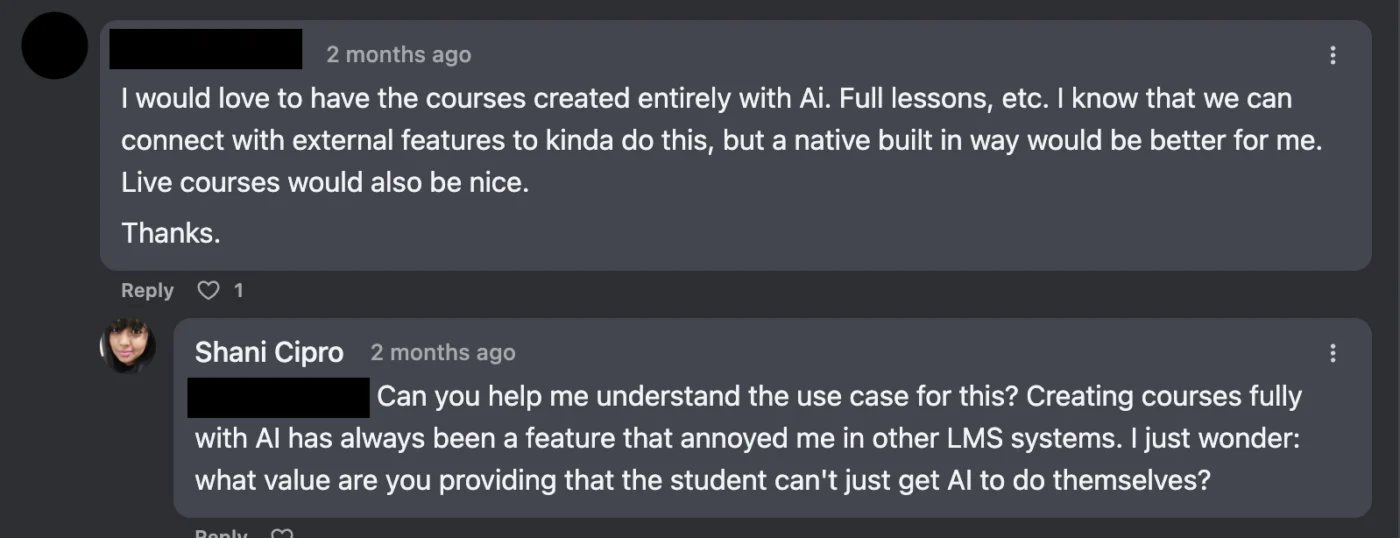
I actually asked this question to someone on a community I'm part of not long ago. They didn't have an answer for me, but I am really worried about where the world is going.
I was never a fan of dropshipping, but this seems worse. It's a form of knowledge dropshipping that doesn't even pay the people who provided the knowledge in the first place.